
Playbooks
What Is Content Repurposing? Meaning, Examples and Common Misconceptions
Content repurposing means taking an existing piece of content and rebuilding it in a new format or for a new context. This article explains what that actually involves, clears up the most common confusions about recycling versus repurposing, and walks through practical examples relevant to founders, marketers and employee advocates on LinkedIn.

Most people who think they are repurposing content are actually recycling it. They take a LinkedIn post that performed well, wait a few months, and post it again with minor edits. That is a legitimate tactic, but it is not repurposing. The distinction matters because recycling and repurposing serve different goals, and confusing the two leads to a content calendar that feels efficient but rarely grows your reach.
Content repurposing means taking an existing asset and rebuilding it into a new format or adapting it for a different audience context. The underlying idea stays the same; everything else changes to suit the platform and the way people consume content there.
What Repurposing Actually Means
The clearest definition comes from the industry sources that have been covering this topic longest. Content repurposing is the process of taking existing content and adapting it for a new format, channel, audience, campaign or business goal. The operative word is adapting. You are not distributing the same file in a new place. You are reshaping the idea so that it communicates clearly in a context with different norms, different scroll behaviour and often a different audience segment.
A related term worth knowing is content atomisation, which is a specific form of repurposing where a large asset is broken into smaller standalone pieces. A webinar becomes five short clips. A detailed report becomes a series of posts, each focused on one finding. Content atomisation is a subset of the broader repurposing idea, not a separate strategy.
The Digital Marketing Institute frames it practically: repurposing content means adapting it or breaking it up to use for another purpose, for example taking an infographic and turning it into individual images that each carry a single point and work inside a social post or an email. The format changes, the platform changes and usually the presentation changes too.
What Repurposing Is Not
Clearing up the misconceptions early saves a lot of wasted effort.
Repurposing is not recycling. Recycling means reposting or lightly refreshing existing content. You change a date, update a statistic, re-queue a post. That extends shelf life. Repurposing rebuilds content into a new format with a new hook, structure and platform-native presentation. Both have uses, but only one genuinely extends reach to audiences who would not have seen the original.
Repurposing is not copy-pasting across channels. Posting the same paragraph on LinkedIn, Twitter and your newsletter on the same day is cross-posting, not repurposing. Each platform has its own grammar: LinkedIn rewards specificity and professional context; a newsletter allows longer explanation; a short video clip has five seconds to earn attention. Taking a strong idea and rebuilding it to fit how people actually read or watch on each platform is the work repurposing requires.
Repurposing is not a rescue strategy. It is tempting to repurpose content that underperformed, hoping a new format will fix it. But the format is rarely the problem when something does not land. Repurposing works best with content that already demonstrated genuine usefulness or resonance. Evergreen material, things that remain relevant regardless of when someone encounters them, makes the strongest foundation for a repurposing workflow.
Repurposing does not create duplicate content problems. This is a common concern for anyone thinking about SEO. Search engines penalise identical text published on multiple pages. Repurposed content avoids this because each derivative piece uses different wording, different structure and a different format. A LinkedIn post drawn from a blog article is a distinct piece of content even when the underlying idea is the same.

Clearing up the most common confusions before building a repurposing workflow.
Practical Examples for LinkedIn
For founders, B2B marketers and employee advocates, the most useful repurposing paths tend to start with a substantial asset and work outward to shorter, more specific LinkedIn formats.
From a long-form article or report to LinkedIn posts. A blog article with five major sections can generate five standalone LinkedIn posts, one for each point. Each post takes the insight from that section, gives it a platform-appropriate opening line and stands alone without requiring the reader to have seen the original. This is one of the most reliable paths for teams that already have a content archive but struggle to maintain consistent posting.
From a webinar or internal presentation to written content. If a founder or subject matter expert has delivered a talk, presented at a team meeting or hosted a customer webinar, that material is ready to be reshaped. A transcript produces a long-form article. The article produces post drafts. Each section of the slide deck might become its own standalone post or a quote card. The expertise is already there; the repurposing workflow surfaces it in formats people will encounter on LinkedIn.
From a podcast episode to text content. Typing up the core argument from a podcast episode into a blog post, and then breaking that post into individual LinkedIn posts, is a well-established path for B2B content teams. The video-to-text approach works on the same principle and is particularly effective for supporting SEO alongside LinkedIn reach.
From a guide or ebook to a LinkedIn newsletter series. Comprehensive written resources can be converted into bite-sized newsletter issues that each cover one chapter or one idea. Readers who would not download a full ebook may engage with a focused newsletter piece that answers a specific question.
From a client conversation or case study to a LinkedIn narrative post. For employee advocates, a customer call recap or a solved problem is a natural source of content. With appropriate context and any necessary anonymisation, the real-world lesson from that conversation becomes a post that colleagues across the team can relate to and build on.
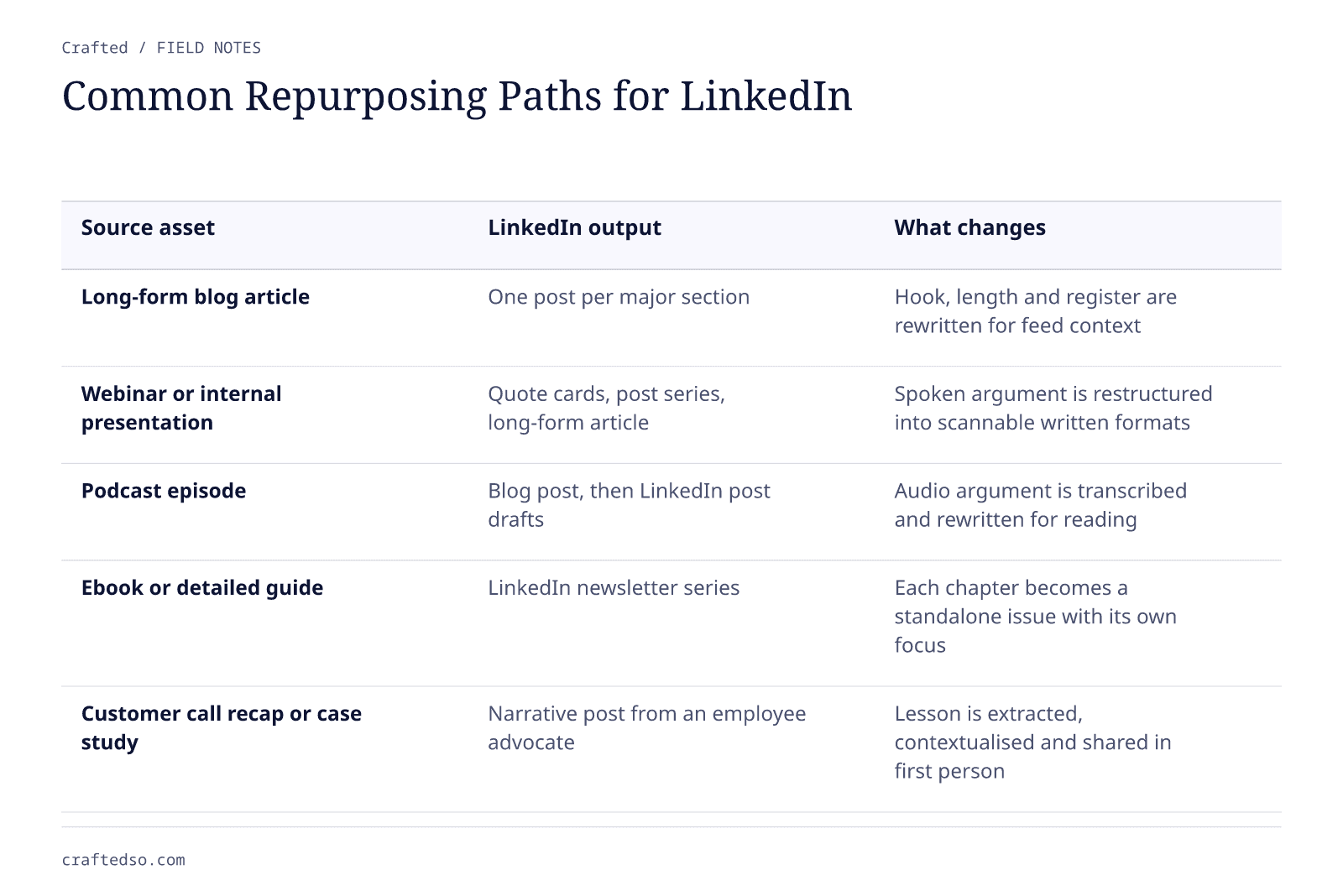
Practical conversions relevant to founders, B2B marketers and employee advocates, drawn from documented B2B content workflows.
When Repurposing Earns Its Place
Repurposing is not the right move for every piece of content, and it is not a substitute for generating genuinely useful ideas. It earns its place in three specific situations.
The first is when you have high-quality evergreen material that has only reached one audience in one format. A detailed article that a niche audience found useful may contain ideas that a completely different audience on LinkedIn would benefit from, if those ideas were expressed in a format and register suited to that platform.
The second is when a team needs to maintain a consistent LinkedIn presence without asking every contributor to generate entirely new ideas each week. Most founders and subject matter experts are not short of expertise; they are short of time and often uncertain about how to translate what they know into LinkedIn content. A repurposing workflow lets an existing asset, a report, a presentation, a well-argued internal email, become several weeks of post material without requiring a blank-page creative effort each time.
The third is when you are trying to reach audiences across more than one channel without producing a proportionally larger volume of original content. Repurposing is not a shortcut around quality; it is a way to make the most of content that already demonstrates quality.
It is worth being direct about what repurposing does not guarantee. No controlled study reviewed in preparing this article provides hard data on a specific reach or revenue lift attributable solely to a repurposing workflow. The efficiency and consistency benefits are well-evidenced. Specific outcome numbers are not, and any source claiming otherwise should be read carefully for a traceable primary source.
What to Check Before You Start
Not all source material repurposes well. Before committing to a repurposing effort, it is worth running a short check across three questions.
First, does the original content contain a genuinely useful idea, or is it filler? Repurposing amplifies what is already there. If the original is vague or outdated, the derivative content will be too.
Second, does the idea translate to the target platform? Some content is inherently visual and becomes weaker as text. Some text is detailed in a way that LinkedIn's short-form environment cannot do justice to without significant rewriting. The goal is platform-native communication, not platform-native copying.
Third, will the voice hold up? For individuals and teams who have invested in a distinctive way of communicating, the repurposed version needs to feel like it came from the same person or organisation. Format changes are expected; a wholesale change in tone is disorienting for an audience that has developed expectations.

A short test that helps you decide whether a piece of content is worth the effort of repurposing.
The Place Repurposing Holds in a Sustainable Content Workflow
Content repurposing is not a standalone tactic. It works best as part of a larger workflow where original content is created with repurposing in mind, where the team knows which assets are worth returning to, and where the process of adapting content does not become more effort than generating it fresh.
For teams building a LinkedIn presence across several contributors, repurposing also creates natural coordination opportunities. A well-argued post from one team member, drawn from a company report, can be the starting point for related posts from others, each bringing their own perspective to the same underlying idea without duplicating each other's content.
The practical starting point is usually the archive. Look at what you have already published or presented that still holds up. Identify the pieces that contained a concentrated insight. Then work backward: what format would surface that insight most cleanly for a LinkedIn audience, and what specific rewriting would make it feel native rather than transplanted?
That process, applied consistently, is what turns a single piece of useful thinking into a durable part of your content presence rather than a one-time post that disappears from the feed within twenty-four hours.
If you are building a consistent LinkedIn presence and looking for a workflow that makes repurposing easier across a team, Crafted's platform is designed around exactly that problem. You can also book a demo to see a week of drafted content for your team before committing to anything.
Sources: MediaValet: Content Repurposing Definition · Digital Marketing Institute: Content Repurposing · Advergize: Content Repurposing · Ross Simmonds: What Is Content Repurposing? · Cognism: Content Repurposing · Dave Chaffey: Content Repurposing Definition · The Ardent Blogger: Content Repurposing Ideas · eepartnergroup: What Is Content Repurposing · Sleekpost: What Is Content Repurposing · ON24: What Is Content Repurposing · fame.so: B2B Content Repurposing Strategies · Juicer: Repurposing B2B Content for LinkedIn · Scopicstudios: B2B Content Repurposing
Autopilot
Draft your team’s first week, in their voices
Crafted writes the posts, checks your guardrails and lines up the calendar. Your team just approves.
MORE FROM CRAFTED


