


To generate leads on LinkedIn through content, define a specific buyer, make your profile and offer clear, publish answers to that buyer’s questions, and invite relevant conversations. Follow up when there is genuine interest, then track which conversations become qualified opportunities.
A reaction is a signal of engagement, not proof that someone wants to buy. The aim is to make your expertise useful and your next step easy to understand.
1. Define a lead before chasing reach
Write down who you can help, which problem you solve, and what makes that problem worth addressing now. A qualified lead should fit your audience and show interest in discussing a relevant need.
For example, a team selling onboarding software might focus on operations leaders dealing with inconsistent handoffs. That is more actionable than trying to reach every founder on LinkedIn.
Agree on a simple qualification checklist with sales: relevant role or influence, a problem you address, and willingness to explore a next step. Avoid counting every new follower as pipeline.
2. Make the path from profile to offer clear
When someone visits your profile, they should understand what you do and whom you help. Use plain language in your headline and summary. Point to a relevant website page or resource through the profile options available to you.
The destination should continue the same conversation. A post about onboarding handoffs should lead to a useful explanation, checklist, or focused service page. Sending every reader to a broad homepage creates extra work for them.
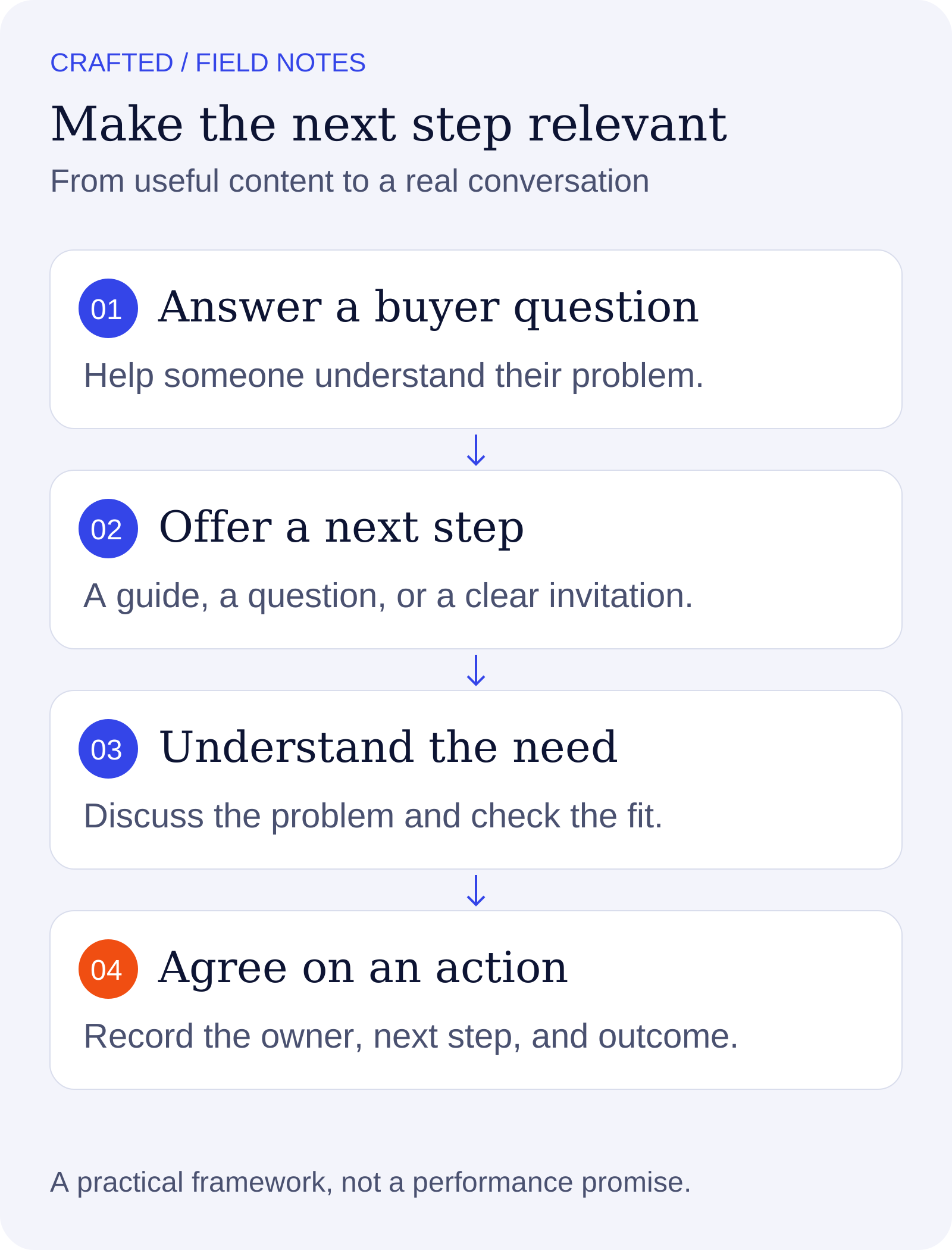
This is a planning model, not a guaranteed or strictly linear buyer journey.
3. Publish around buyer questions
Build a content plan around three types of questions: how to recognize the problem, how to evaluate possible approaches, and what implementation involves. Ask customer-facing teammates which questions recur before someone decides to buy.
A useful sequence might explain why handoffs fail, show a simple ownership checklist, then describe the tradeoffs between a manual process and dedicated software. Each post should stand on its own while helping readers move toward a more informed decision.
Use real evidence where you have it. Describe examples as hypothetical when they are illustrative. Do not invent a customer story to make an offer sound proven.
4. Match the invitation to the reader’s intent
For an educational post, offer a related guide or ask a focused question. For a post about evaluating solutions, invite the reader to discuss their situation. Make clear what they will receive and what, if anything, you need from them.
Example: “If your team is rebuilding its onboarding process, the checklist covers the five handoffs to map first.” A direct resource link can be useful when the resource is ready and relevant.
If someone asks a substantive question, answer it before introducing a sales conversation. A thoughtful response demonstrates the expertise your post promised.
5. Follow up with context and permission
Reference the actual conversation and explain why the follow-up is relevant. An illustrative message is: “You mentioned that approvals slow down onboarding. Would it help if I shared the handoff checklist we discussed?”
Avoid treating a like, a connection acceptance, or a profile visit as permission for a repeated sales sequence. Let the person’s response guide the next step. LinkedIn also warns against artificial engagement in its guidance on authentic content and conversations.
6. Track conversations through to outcomes
Keep a simple record of the person or company, the topic that started the conversation, the need discussed, the agreed next step, and the outcome. Use campaign-tagged website links when you can measure visits, and ask prospects how they heard about you.
Separate leads that began directly from a post from deals where content helped build familiarity. A prospect may read several posts before contacting you through another channel, so one tracked click rarely explains the whole journey.
Review the process monthly: which questions attracted relevant people, which invitations led to conversations, and which conversations met your qualification criteria? Improve the weak step before increasing publishing volume.
What is the difference between engagement, a lead, and an opportunity?
Engagement is an interaction with your content. A lead is an identifiable person or organization showing relevant interest. An opportunity is a potential deal your sales process has qualified for further work. Define these terms internally so your reporting does not count attention as revenue.
A person liking a checklist has engaged. A relevant buyer asking for help applying it may be a lead. If a conversation establishes a problem you can solve and an agreed evaluation step, your team may classify it as an opportunity. Your exact criteria should match your business and buying cycle.
Which content should you publish at each stage?
Publish content that helps readers recognize a problem, evaluate approaches, and understand the work involved in a solution. These are useful planning categories, not a guarantee that every buyer will follow a fixed sequence.
Help readers recognize the problem
Explain symptoms, common mistakes, or the cost of leaving a process unclear. For an onboarding product, a post might show how unclear ownership causes a handoff to fail. The reader should finish with a better diagnosis, even if they never buy anything.
Help readers compare approaches
Explain the tradeoffs between options. A manual checklist may suit a small team; a more complex operation may need dedicated software. Be explicit about the conditions behind your recommendation. Useful comparisons demonstrate judgment rather than treating every situation as a reason to buy.
Help readers plan the next step
Share implementation questions, preparation checklists, or a clear explanation of your service. Tell readers what a discovery call or demonstration covers. Removing uncertainty makes an invitation easier to evaluate.
How do you start a conversation without a hard pitch?
Start with the question or problem the other person actually raised. Answer it, check whether more help would be useful, and make any commercial next step explicit.
Illustrative reply: “You mentioned that new customers miss the handoff email. Is the bigger problem ownership or timing? The checklist has a section for each.”
If they ask for help: “Happy to walk through the handoff. If it looks like our product might fit, I can explain that too. Would a short call be useful?”
These examples work only when they fit a real exchange. Do not paste them into unrelated conversations. If someone is simply sharing an opinion, a thoughtful public reply may be the right endpoint. You do not need to convert every interaction into a private message.
What should a simple LinkedIn lead tracker contain?
Use a spreadsheet or your existing CRM to record the evidence needed for a follow-up. You do not need a complicated attribution model to start learning from conversations.
Contact and company: the person who has actually entered the conversation.
Source: the post, topic, referral, or self-reported reason they contacted you.
Need and fit: the problem they described and why it relates to your offer.
Status: interested, qualified, evaluating, won, lost, or not a fit, using your own definitions.
Next step: the action agreed, the owner, and the expected date.
Outcome: what happened and why, including no decision.
Use the same reporting period and definitions when comparing results. For example, qualified conversations divided by all substantive inbound conversations can show whether you are attracting the right needs. Do not treat a change in that rate as proof that content alone caused it; offer, audience, and follow-up can change too.
What should you do when content gets views but no leads?
Check the connection between the audience, topic, and offer before publishing more often. A useful post may reach people who enjoy the idea but have no reason to buy your service.
Check audience fit. Are the people responding similar to the buyers you can help?
Check problem fit. Does the subject relate to a problem your offer actually addresses?
Check the destination. Does your profile or linked page explain a relevant next step?
Check the conversation. Are you answering questions and following through on requests?
Check the time horizon. Are you evaluating results in the context of your buying cycle?
Use the answers to choose the next experiment. If the audience is right but the offer is unclear, improve the explanation of the offer. If inquiries arrive but are poor fits, narrow the topics and qualification language. More reach alone will not repair either problem.
Frequently asked questions
Do I need LinkedIn ads to generate leads?
No. Organic posts and conversations can introduce potential buyers to your work. Paid campaigns are a separate option; neither approach guarantees qualified leads.
How quickly should I expect results?
There is no reliable universal timeline. Your existing network, audience fit, offer, consistency, and buying cycle all matter. Use an initial month to establish a baseline rather than promise a revenue result.
Can a team contribute without posting the same message?
Yes. Give people different topics based on their experience while keeping the audience and business context aligned. Distinct perspectives make the program more useful.
Start with content worth responding to
Read the foundations of effective LinkedIn content. To organize contributions across your team, explore what Crafted does or talk with us about your workflow.
Autopilot
Draft your team’s first week, in their voices
Crafted writes the posts, checks your guardrails and lines up the calendar. Your team just approves.
MORE FROM CRAFTED


