
Playbooks
Personal Branding on LinkedIn: What It Actually Means
Most people think a polished profile and a few posts count as a personal brand. They don't. This article explains what personal branding on LinkedIn actually means, why it matters for founders, subject matter experts and marketing leaders, and how to build one that holds up over time.

The sentence you're not controlling yet
Here is a useful test. If a buyer, recruiter or potential partner searched your name right now and then had to describe you to a colleague in one sentence, what would they say? Most professionals on LinkedIn cannot answer that question confidently, not because they lack expertise, but because they have never made it explicit.
That gap is what personal branding actually addresses. Not the colour of your banner image or how often you post, but the deliberate, consistent work of making sure the sentence other people say about you reflects who you actually are and what you genuinely know.
Personal branding on LinkedIn is the strategic act of making your expertise, perspective and professional voice visible to the people who need to find you. It is not about constructing a persona or performing enthusiasm for an audience. It is about ensuring that when someone looks you up, what they find is accurate, useful and recognisably yours.
What a personal brand actually consists of
Strip away the noise and a personal brand on LinkedIn has three parts, each one compounding the others.
The first is expertise: the specific territory you are known for and can be trusted on. Not a broad category like "marketing" or "finance," but a focused position that tells someone immediately whether you are relevant to their problem. A founder who has scaled two B2B SaaS companies to Series A has a different expertise claim than a generalist growth consultant, even if they post about similar topics.
The second is voice: the way you think and communicate about your field. This is the most overlooked element. Two people can hold the same opinions about product strategy, but one writes with precision and dry wit while the other leads with data and structured frameworks. Those are different voices and they attract different readers. Voice is not a stylistic affectation; it is the signature that makes your content recognisable before anyone sees your name.
The third is consistency: showing up regularly enough that recognition compounds. One insightful post does not build a brand. A focused body of work over several months does. According to Taplio's analysis of the platform, over one billion people have LinkedIn accounts, yet only around one percent of users create content with any regularity. That gap is an opportunity, but only for people who sustain the habit.

Expertise, voice and consistency work together. Remove one and the others lose their power.
Thought leadership is often confused with personal branding, but they are not the same thing. Personal branding is how people perceive you across the full picture of your profile, activity and reputation. Thought leadership is a subset: sharing original insights and frameworks that influence how others in your industry think. You need personal branding to be recognised. You need thought leadership to be trusted. The strongest LinkedIn presences combine both.
Why it matters for founders, SMEs and marketing leaders
The case for individual voices on LinkedIn is structural, not just philosophical. Analysis of more than 673,000 LinkedIn posts found that personal profiles generate a 2.60% engagement rate compared to 1.74% for company pages, a difference of around 63% in favour of individuals. A separate feed analysis by DSMN8 found personal profiles account for roughly 62% of what users see in their feed, compared to about 5% for company pages. These are not marginal differences. They reflect how the platform distributes attention.
For founders, that gap has direct commercial implications. Research cited in the 2025 Edelman and LinkedIn B2B Thought Leadership Impact Report indicates that 70% of C-suite buyers say a leader's LinkedIn presence directly influences which companies they invite into a request for proposal process. Being absent from a buyer's feed is not neutral; it is a competitive disadvantage.
For subject matter experts inside larger organisations, the logic is different but equally clear. An engineer or product manager who explains their thinking publicly builds credibility that their company page cannot replicate. Their posts carry authenticity that a branded announcement does not. When several people across a team post consistently, the cumulative reach multiplies in a way that no single company page can match.
For marketing leaders, this creates a coordination challenge. Individual voices perform better, but individual posting habits are unpredictable. The practical answer is not to suppress individual voices in favour of a company page, but to give people the structure, topics and guidance that let them post in their own voice without starting from scratch every time.
Four misconceptions worth dropping
Posting every day builds a brand. It does not. Several practitioners and sources including ConnectSafely's 2026 best practices analysis converge on three to five posts per week as a more sustainable and effective target. Posting a mediocre update daily erodes authority; a well-considered post three times a week compounds it. The Ehrenberg-Bass Institute's work on brand salience is instructive here: quality and mental availability matter far more than raw frequency.
A viral post changes everything. A single post reaching a large but untargeted audience generates far fewer useful outcomes than a focused post reaching the right five thousand people in your market. LinkedIn's algorithm in 2026 optimises for professional relevance over raw reach, which means positioning matters more than luck.
Posting frequently is the same as having a strategy. Consistency without positioning is the most common way professionals waste time on the platform. Frequency becomes a strategy only when it is anchored to a clear point of view, a defined audience and a set of topics that reinforce the same expertise signal over time. The professionals who see compounding growth are not the most prolific posters; they are the most consistently positioned ones.
Generic content is a shortcut to credibility. Audiences have developed a sharp sensitivity to generic content regardless of how it was produced. The credibility signal on LinkedIn is the person and their actual knowledge. That is why platforms designed to help people post more sustainably work best when they draw on the individual's real voice and real work as raw material, not when they replace it.
Common advice about posting frequency, virality and content shortcuts often points professionals in the wrong direction.
When personal branding starts to pay off, and how long it takes
Expect three to six months of consistent, positioned posting before the results become visible. Profile views and inbound messages typically grow before follower count does, which means early traction is often invisible to people who are watching the wrong metric.
The threshold for teams starting an employee advocacy effort is lower than most organisations assume. Three to five genuinely willing contributors is enough to see a measurable difference in reach, according to practitioner analysis. The challenge is sustaining it. Around 75% of employee advocates report receiving no formal social media training from their employer, according to Hinge Research Institute data. People do not avoid posting because they lack things to say; they avoid it because they do not have a clear structure for what to say or how to say it in a way that feels right.
Leadership participation matters disproportionately. Sprout Social's 2025 research found that companies where C-suite executives actively take part in employee advocacy programs see 2.4 times higher employee participation rates than those where leadership stays off the platform. When founders and executives post consistently, they set a visible standard and signal that it is safe and worthwhile for others to do the same.
That timing question, three to six months before real traction, is also why building a repeatable system matters more than occasional bursts of effort. A good week of posts followed by three weeks of silence resets the recognition clock. Sustained presence, even at a modest volume, outperforms irregular intensity.
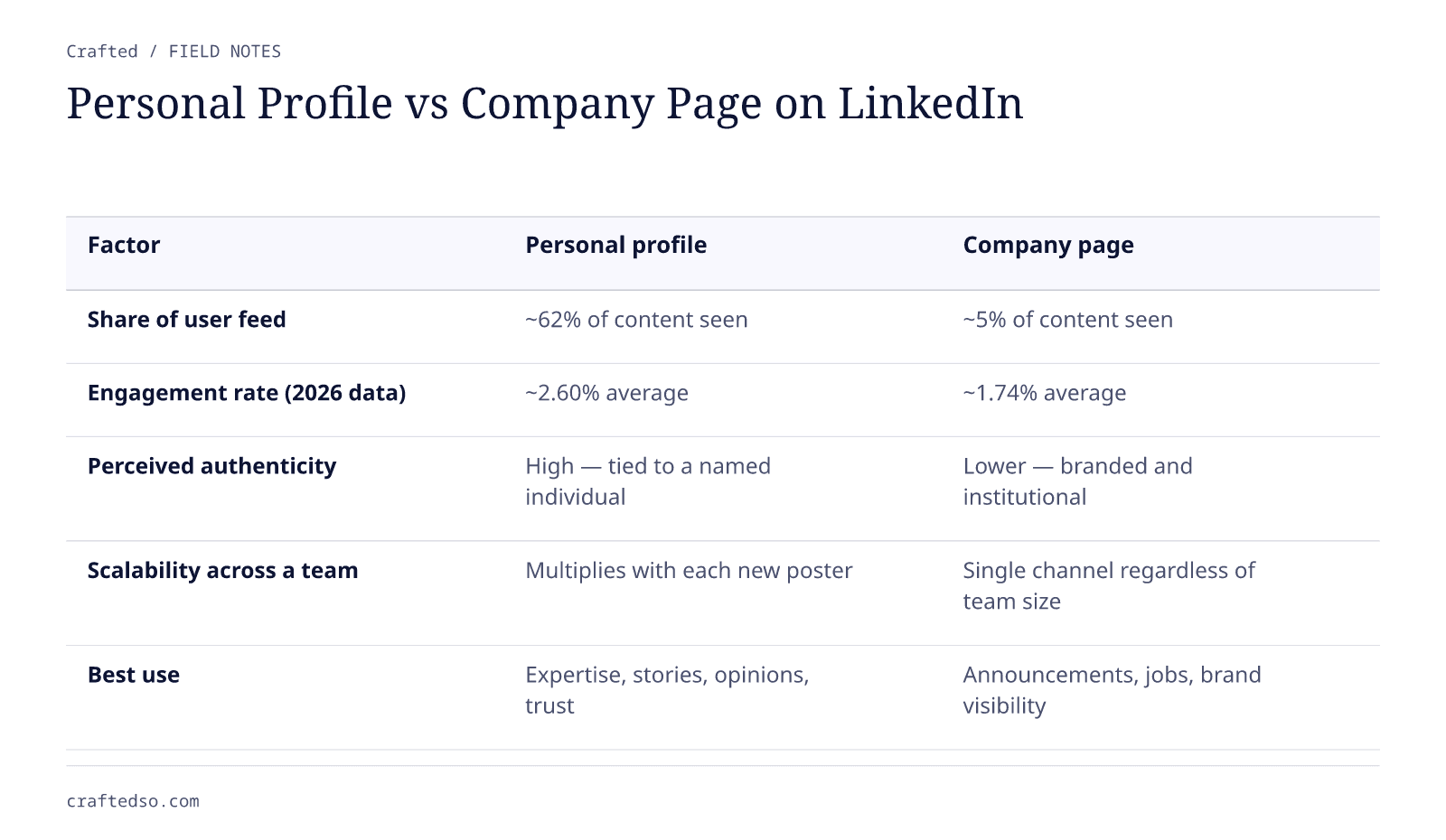
Structural differences that explain why individual voices outperform branded pages, and what that means for how you allocate effort.
Building the habit without losing your voice
The practical starting point is deciding what you want to be known for. Not a general category, but a specific intersection: the kind of problem you solve, the kind of person you help, and the lens through which you see your field. That intersection becomes your positioning anchor, and every piece of content you publish should pull from it or add to it.
From there, the work is setting a rhythm you can sustain, identifying the formats that suit how you naturally communicate, and building a process for moving from an idea to a published post without spending an hour on each one. For many people, that means having a small library of recurring formats: a short opinion, a process breakdown, a story from the work, a response to something happening in the industry. Rotating through a handful of formats removes the blank-page problem without making every post feel the same.
For teams, the additional layer is shared guidance: clear content pillars that connect individual posts to the company's broader message, without requiring every person to sound like a press release. An engineer explaining a technical tradeoff should not sound like a founder discussing company strategy. The goal is coherence at the brand level and authenticity at the individual level, which is why the most effective team content systems capture each person's voice separately rather than flattening everyone into a single tone.
If you are starting from scratch, the lowest-friction entry point is to write about something you genuinely know and would explain differently than anyone else in your field. That specificity is the beginning of a brand.
Crafted is built around exactly this problem: giving individuals and teams a structure that keeps content consistent with the brand without making everyone sound the same. If you want to see how it works in practice, the individuals page and the demo are the right starting points.
Autopilot
Draft your team’s first week, in their voices
Crafted writes the posts, checks your guardrails and lines up the calendar. Your team just approves.
MORE FROM CRAFTED


